Marketing ROI for Home Improvement Businesses Explained
Learn how to track marketing ROI for home improvement businesses, from lead source to final payment, and book a personalized workflow demo today.

Marketing ROI for home improvement businesses is the one number that separates a profitable campaign from an expensive guessing game. Roofing, siding, window, and remodeling companies often track leads and clicks with great precision, yet many lose the thread the moment an estimate turns into a signed contract. As a result, marketing budgets get set by gut feeling instead of real production outcomes. This guide goes well beyond a basic lead-generation checklist. Specifically, it shows exactly how to calculate marketing ROI for home improvement businesses, how to dodge the tracking mistakes that quietly inflate the number, and how linking sales data to production and final payment turns a vague percentage into a decision you can actually trust.
Quick answer: Marketing ROI for home improvement businesses equals net profit from marketing-sourced jobs divided by total marketing spend, multiplied by 100. Track it channel by channel, from the first phone call to the final payment, and you will see exactly which campaigns produce profitable installs rather than just cheap leads.
Tracking results by channel, not just by lead count, is the first step toward accurate marketing ROI for home improvement businesses.
What Is Marketing ROI for Home Improvement Businesses?
Marketing ROI for home improvement businesses is a ratio that compares the profit earned from marketing-generated jobs against what it cost to generate them. In practice, it answers one question: for every dollar spent on a lead source, how many dollars came back in signed, completed, and paid jobs? Unlike a generic retail return on investment calculation, home improvement ROI has to account for the full project cycle, including estimates that never close and jobs that stall mid-production.
Specifically, the formula is: (Revenue from Marketing-Sourced Jobs − Marketing Cost) ÷ Marketing Cost × 100. However, the accuracy of that formula depends entirely on how well a company tracks lead source, appointment outcome, and final job value in one place. Without that connection, the resulting percentage is really just a guess dressed up as a metric — and that gap is exactly where most contractor marketing advice stops short.
Why Marketing Return on Investment Matters More Than Lead Volume Alone
Home improvement marketing budgets are not small. In fact, many companies spend five to six figures a month across digital ads, direct mail, home shows, and referral programs. Therefore, knowing which channels produce profitable jobs — not just cheap leads — determines whether that spend grows the business or quietly drains it.
Industry research backs this up. According to HubSpot's marketing benchmarking research, marketers who calculate return on investment are significantly more likely to secure larger budgets and executive buy-in, simply because they can show concrete results instead of vanity metrics like impressions or click volume. Similarly, the U.S. Census Bureau's American Housing Survey shows that homeowners spend well over $500 billion annually on home improvement projects. That means the addressable market is enormous, but so is the competition for that spend.
In contrast to a one-time retail purchase, a home improvement sale often closes weeks after the first lead and depends on estimate approval, financing, material availability, and crew scheduling. Consequently, a channel that looks strong on cost-per-lead (the price paid to generate one inquiry) can still produce a poor ROI if those leads rarely survive the full sales cycle. A lead-generation strategy that stops at "how many calls did we get" is, frankly, only telling half the story.
The Marketing Channels Contractors Use — and How Each One Affects ROI
Before you can improve marketing ROI for home improvement businesses, it helps to understand how each major channel behaves differently once you follow it all the way to a completed job. Below are the channels most residential contractors rely on, along with the ROI nuance each one introduces.
Search Engine Optimization (SEO)
SEO is the practice of ranking organically in search results without paying per click. Because organic leads often take months to build, their ROI tends to look weak in the first quarter and strong a year later. As a result, SEO should be judged on a longer timeline than paid channels.
Pay-Per-Click (PPC) Advertising
PPC campaigns generate fast, trackable leads, which makes them easy to measure on cost-per-lead. However, PPC leads are often priced on competitive keywords, so the real test of ROI is whether those leads close at a high enough rate to justify the premium.
Social Media Advertising
Social ads are useful for building brand awareness and retargeting past website visitors. In particular, they tend to produce lower-intent leads than search ads, so tracking them through to a signed, paid job is essential before trusting the cost-per-lead number alone.
Direct Mail
Direct mail still performs well in many local markets, especially for roofing and exterior companies. Even so, mail campaigns are notoriously hard to attribute unless every incoming call or form is tagged with a unique source code at intake.
Home Shows and Local Events
Home shows generate a concentrated burst of leads with a long tail of follow-up. Consequently, ROI for a single event often cannot be judged until 60 to 90 days later, once the slower-moving leads have had time to book estimates.
Referral and Repeat-Customer Programs
Referrals typically produce the highest ROI of any channel because the cost per lead is low and the close rate is high. Above all, this makes referral tracking one of the most undervalued pieces of a contractor's marketing strategy.
A 5-Step Framework to Calculate Your Home Improvement Marketing ROI
Calculating marketing ROI for home improvement businesses is straightforward once the right data is connected. The process below works whether a company runs one location or several, and it mirrors how production-ready CRM platforms typically structure the workflow.
- Tag every lead with its source at intake. Record whether a lead came from paid search, a home show, direct mail, or a referral the moment it enters the pipeline, so nothing gets lost later.
- Connect each lead to its appointment and estimate outcome. Track whether the lead booked an appointment, received an estimate, and signed, because a lead that never reaches an estimate cannot be counted as a sale.
- Record actual job revenue once production is complete. Use the final invoiced amount rather than the original estimate, since change orders and material costs often shift the real number.
- Calculate ROI per channel using the standard formula. Subtract total marketing spend for that channel from the revenue it produced, divide by the spend, and multiply by 100 to get a percentage.
- Review results monthly and reallocate budget accordingly. Shift spend toward channels that consistently produce profitable, completed jobs, and reduce spend on sources that generate volume but little closed revenue.

Connecting lead source data to completed job revenue is essential for calculating marketing ROI for home improvement businesses accurately.
Common Mistakes That Skew Marketing ROI Tracking
Even well-intentioned teams make errors that distort their numbers. For example, many companies count a "sale" the moment a contract is signed, instead of waiting until the job is produced and paid. As a result, cancellations and failed financing applications inflate ROI on paper while hurting cash flow in reality.
Another common mistake is tracking leads and jobs in separate systems. When sales data lives in a spreadsheet and production data lives in a different tool, somebody has to manually match records, and that work often falls behind or gets skipped entirely. In addition, companies frequently ignore the cost of staff time spent following up on leads, which understates the true marketing cost and overstates ROI. Above all, inconsistent source tagging — where "Facebook," "FB Ads," and "Social" are treated as three different channels — makes it nearly impossible to compare performance over time.
Marketing ROI vs. ROAS, CPL, and CAC: What's the Difference?
Contractors often use several metrics interchangeably, but each one answers a different question. Understanding the difference prevents a company from celebrating a number that looks good but hides a weak channel.
- ROAS (Return on Ad Spend): Compares ad revenue to ad cost alone, ignoring production and overhead costs. It is useful for comparing campaigns within the same channel, but it overstates profitability.
- CPL (Cost Per Lead): The amount spent to generate one inquiry. A low CPL feels good, but it says nothing about whether that lead ever turns into a signed, completed job.
- CAC (Customer Acquisition Cost): The total cost, including sales time, to convert a lead into a paying customer. CAC is a more honest number than CPL because it accounts for the full funnel.
- Marketing ROI: Accounts for profit after production and overhead costs, which makes it the most complete measure of whether a channel is genuinely worth the spend.
What Is a Good Marketing ROI Benchmark for Home Improvement Companies?
Benchmarks vary by market, trade, and season, but most established home improvement companies aim for a positive ROI of at least 200 to 300 percent on paid channels after accounting for production costs. That said, the range differs meaningfully by channel:
- Referral programs: Often 400 percent or higher, thanks to low acquisition cost and strong trust.
- SEO and organic search: Typically 250 to 400 percent once the channel matures past its first year.
- Pay-per-click advertising: Commonly 150 to 300 percent, depending on keyword competition and close rate.
- Direct mail: Usually 100 to 250 percent, with wide variation by list quality and offer.
- Home shows and events: Often 100 to 200 percent once slower-closing leads are fully accounted for.
These ranges are starting points, not guarantees. Ultimately, the only benchmark that matters is your own company's trend line over time, compared channel by channel.
Connecting Marketing Performance to Sales and Production
Marketing ROI for home improvement businesses becomes far more reliable once lead data, sales data, and production data live in one connected system. For instance, when a sale is recorded and a production job is created automatically, the original lead source travels with that job all the way through material ordering, scheduling, and final payment. Nothing gets rekeyed, and nothing gets lost between departments.
This kind of connection also helps office staff, sales reps, and production crews stay aligned on the same job without duplicate data entry. A lead management workflow that feeds directly into appointments, estimates, and signatures gives everyone visibility into where a job stands and what it originally cost to acquire. Furthermore, a shared job board that tracks production milestones means a marketing-sourced lead can be followed from the first call all the way to the final install, which is exactly the data needed for an accurate ROI calculation.
Several home improvement companies have documented this kind of before-and-after shift in their reporting accuracy; detailed examples are available in these case studies.
Tools and Reporting That Improve Marketing ROI for Home Improvement Businesses
Spreadsheets can calculate ROI once the data is gathered, but gathering that data manually every month is where most teams fall behind. Workflow CRM platforms built specifically for home improvement companies, such as LeadFlow, are designed to solve this by connecting lead intake, appointments, estimates, signatures, payments, material orders, and production in one private company workspace.
Speed matters here, too. In fact, a widely cited study published in the Harvard Business Review found that companies responding to a new lead within five minutes were dramatically more likely to connect with and qualify that lead than those who waited even thirty minutes. Because a workflow CRM surfaces new leads immediately and routes them to the right rep, faster response time becomes another lever that directly improves marketing ROI.
Because the same job record carries its original lead source from first call to final payment, reporting on marketing performance becomes a byproduct of normal daily work rather than a separate monthly project. Teams that want to compare plans by user count and features can review the pricing page, and month-to-month plans with no long-term contract mean a company can test the reporting fit without a big commitment.
For companies that currently manage leads and jobs in spreadsheets or an older CRM, existing records can typically be migrated into a configured workspace, so historical marketing data is not lost during the switch. Teams curious about how the full workflow looks in practice can walk through a product tour, or visit the LeadFlow homepage to see how the platform fits a home improvement team's day-to-day workflow before booking a personalized demo.
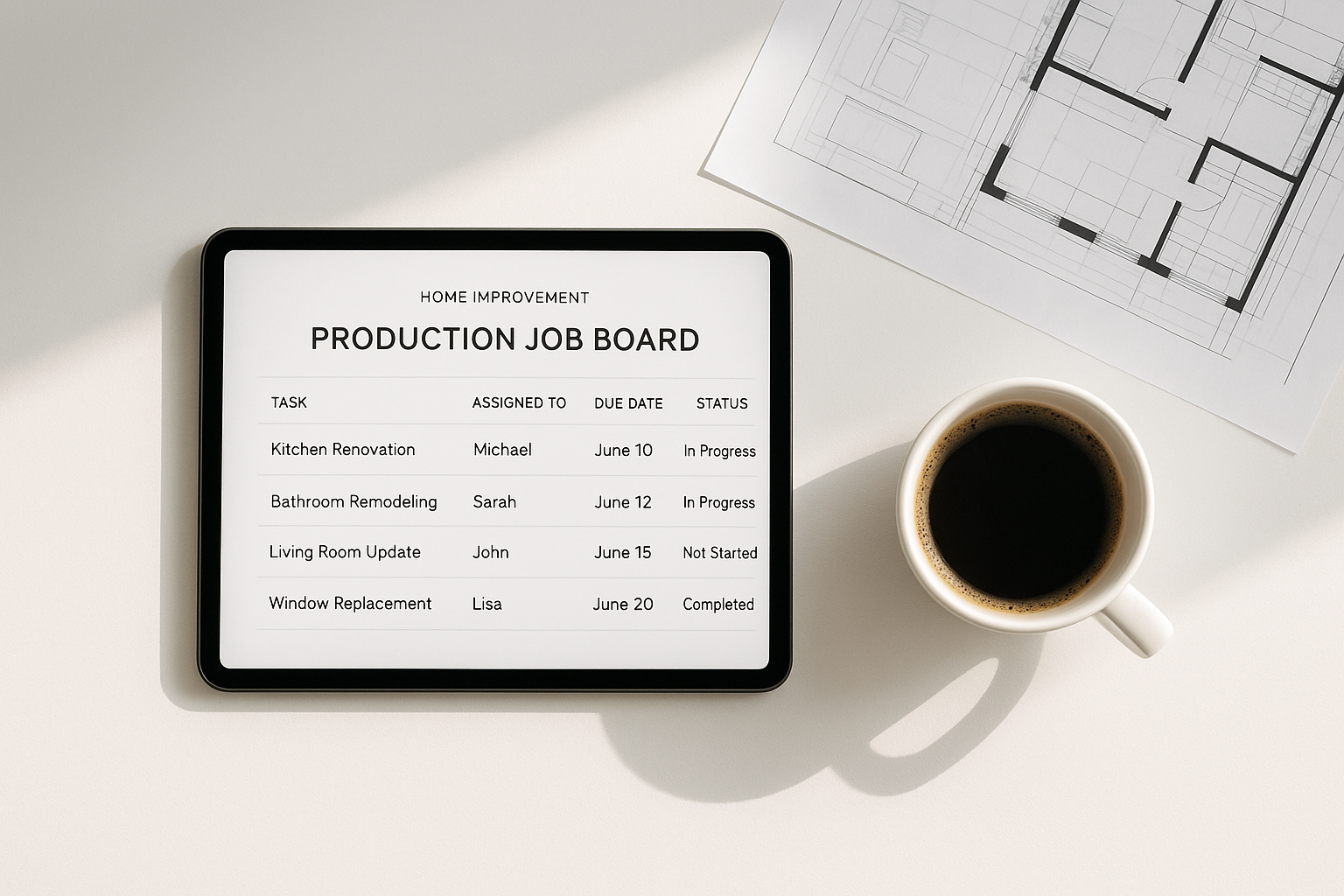
A connected job board helps teams trace every project back to the marketing source that generated it.
How to Build a Marketing Budget Based on ROI, Not Guesswork
Marketing spend commonly ranges from 5 to 12 percent of annual revenue for established home improvement companies, according to general small-business guidance from the U.S. Small Business Administration. Newer companies still building a customer base often spend more, since they lack the referral pipeline that mature companies rely on.
Rather than splitting that budget evenly across channels, the smarter approach is to let ROI data drive the split. In other words, once a few months of connected lead-to-payment data exist, shift a larger share of next quarter's budget toward the channels proving themselves and trim the ones that are not. This is a continuous process, not a once-a-year exercise — because seasonality, material costs, and local competition all shift month to month.
Attribution Models: How to Credit the Right Channel for Each Sale
Attribution is simply the method used to decide which marketing touchpoint gets credit for a sale. Homeowners frequently see a company's name more than once — a social ad, then a Google search, then a referral mention — before they ever call. Therefore, picking the right attribution model matters.
- First-touch attribution: Credits whichever channel first introduced the homeowner to the company, which is useful for measuring brand awareness.
- Last-touch attribution: Credits the final channel before the lead converted, which is the simplest model and the one most home improvement CRMs use by default.
- Multi-touch attribution: Splits credit across every touchpoint in the journey. It is more accurate but requires more sophisticated tracking than most contractors need to get started.
For most home improvement businesses, last-touch attribution combined with consistent source tagging at intake is accurate enough to make confident budget decisions, without the added complexity of multi-touch modeling.
Frequently Asked Questions About Marketing ROI for Home Improvement Businesses
What is marketing ROI for home improvement businesses?
Marketing ROI for home improvement businesses is the percentage return earned from marketing spend once leads turn into signed, produced, and paid jobs. It is calculated by subtracting marketing cost from the revenue those jobs generated, dividing by the cost, and multiplying by 100.
How do you calculate marketing ROI for a home improvement company?
Marketing ROI is calculated using the formula (Revenue from Marketing-Sourced Jobs − Marketing Cost) ÷ Marketing Cost × 100. Accurate numbers depend on tracking lead source, appointment outcome, and final job revenue in one connected system rather than separate spreadsheets.
Why does marketing ROI matter more for home improvement businesses than other industries?
Home improvement sales involve a longer cycle that includes estimates, financing, material ordering, and production scheduling before revenue is finalized. As a result, a channel that looks cheap on cost-per-lead can still produce poor ROI if those leads rarely survive to a completed, paid job.
What is a good marketing ROI benchmark for home improvement companies?
Benchmarks vary by channel and market, but many home improvement companies aim for a positive ROI of at least 200 to 300 percent on paid marketing channels after accounting for production costs. Referral and repeat-customer channels typically produce higher ROI than cold paid advertising.
How much should a home improvement business spend on marketing?
Marketing spend commonly ranges from 5 to 12 percent of annual revenue for established home improvement companies, though newer companies building a customer base often spend more. The right amount depends on growth goals, current close rates, and how efficiently leads convert into production.
How long does it take to see accurate marketing ROI data?
Most home improvement companies need at least one to two full sales cycles, often 60 to 90 days, before marketing ROI data becomes reliable. This allows enough time for leads to move through appointments, estimates, production, and final payment.
What is the difference between marketing ROI and marketing ROAS?
Marketing ROAS, or return on ad spend, compares ad revenue to ad cost alone, while marketing ROI accounts for profit after all production and overhead costs. Consequently, ROI gives a more complete picture of whether a channel is actually profitable for a home improvement business.
What are the most common mistakes when tracking marketing ROI?
The most common mistakes include counting signed contracts as sales before production is complete, tracking leads and jobs in separate systems, and using inconsistent names for the same marketing channel. Each of these errors inflates reported ROI while hiding the true cost of acquiring a job.
How can CRM software improve marketing ROI tracking?
A workflow CRM keeps lead source, appointment, estimate, and production data connected to the same job record, so reporting reflects actual completed revenue instead of estimates alone. This removes the manual work of matching spreadsheets and reduces reporting errors.
Can marketing ROI be tracked across multiple locations?
Yes, marketing ROI can be tracked by location when each office or branch records leads and jobs in its own workspace while reporting rolls up centrally. Enterprise-level CRM plans are generally built to support this kind of multi-location reporting.
What data points are needed to calculate marketing ROI accurately?
Accurate ROI calculations require lead source, marketing spend per channel, appointment and estimate outcomes, and final invoiced job revenue. Without all four data points connected, the resulting ROI number is only a partial estimate.
How does the sales-to-production handoff affect marketing ROI reporting?
When a sale automatically creates a production job, the original lead source stays attached to that job through material ordering, scheduling, and final payment. This means marketing ROI reporting stays accurate even after the sales team hands the job off to production.
Does lead source tracking help improve marketing ROI over time?
Yes, consistent lead source tracking allows a company to compare channel performance month over month and shift budget toward sources that produce profitable, completed jobs. Over time, this typically improves overall marketing ROI for home improvement businesses by reducing spend on underperforming channels.
Does online reputation and customer reviews affect marketing ROI for home improvement businesses?
Yes, strong reviews increase close rates across every channel because homeowners check ratings before booking an estimate. A higher close rate lowers the effective cost per sale, which directly raises marketing ROI without spending another dollar on ads.
How does speed-to-lead response time impact marketing ROI?
Faster response times significantly increase the odds of connecting with and qualifying a new lead. Because more connected leads become more booked appointments, cutting response time is one of the simplest ways to improve marketing ROI without changing a single ad campaign.
Should home improvement companies track customer lifetime value alongside marketing ROI?
Yes, especially for companies with repeat services or multi-phase projects. A channel with modest first-job ROI can still be worth the investment if it reliably produces customers who return for additional work or refer new business later.
How does seasonality affect marketing ROI for home improvement businesses?
Seasonality shifts both lead volume and close rates throughout the year, which means a channel's ROI in peak season may look very different in a slow month. Comparing year-over-year data for the same season gives a more accurate read than comparing adjacent months.
Key Takeaways on Marketing ROI for Home Improvement Businesses
Getting marketing ROI for home improvement businesses right comes down to one habit: keeping lead source data attached to the job all the way through production and final payment. Companies that calculate ROI with disconnected spreadsheets are often making budget decisions on incomplete information, while those that connect sales and production data get a far more honest picture of which channels actually pay for themselves. Ultimately, the goal is not just to report a percentage, but to use it to spend marketing dollars where they produce the most profitable, completed jobs. Teams ready to see this in practice can visit leadflowcrm.info and book a personalized workflow demo.